For a solo act, a good quality microphone might be sufficient by itself. But for a band, you want to have access to different microphone flavours, because if you overdub everything, even with a premium microphone, the final product will sound flat. A good quality studio must have a good collection of microphones, because each style of music and each instrument requires a certain sound and, there is no one type of microphone that fits them all.
If you want to record a concert piano, a matched pair of omni - Earthworks or DPAs - and a large premium condenser are the way to go, especially for classical music and jazz. Of course, two Rodes or AT will do the job, but YOU WILL HEAR THE DIFFERENCE! For reeds nothing beats a good ribbon mic. And staples like Royer R121, Coles 4038, AKG 414’s and 112D, Shure SM7, SM 57, SM 58, Electro-Voice RE-20 and MD 421 Sennheiser are a good bet for drums, percussion, bass, and guitars. While the most important thing for getting a top-quality product is the artist performance, the studio has to be able to provide the right tools to capture that sound.
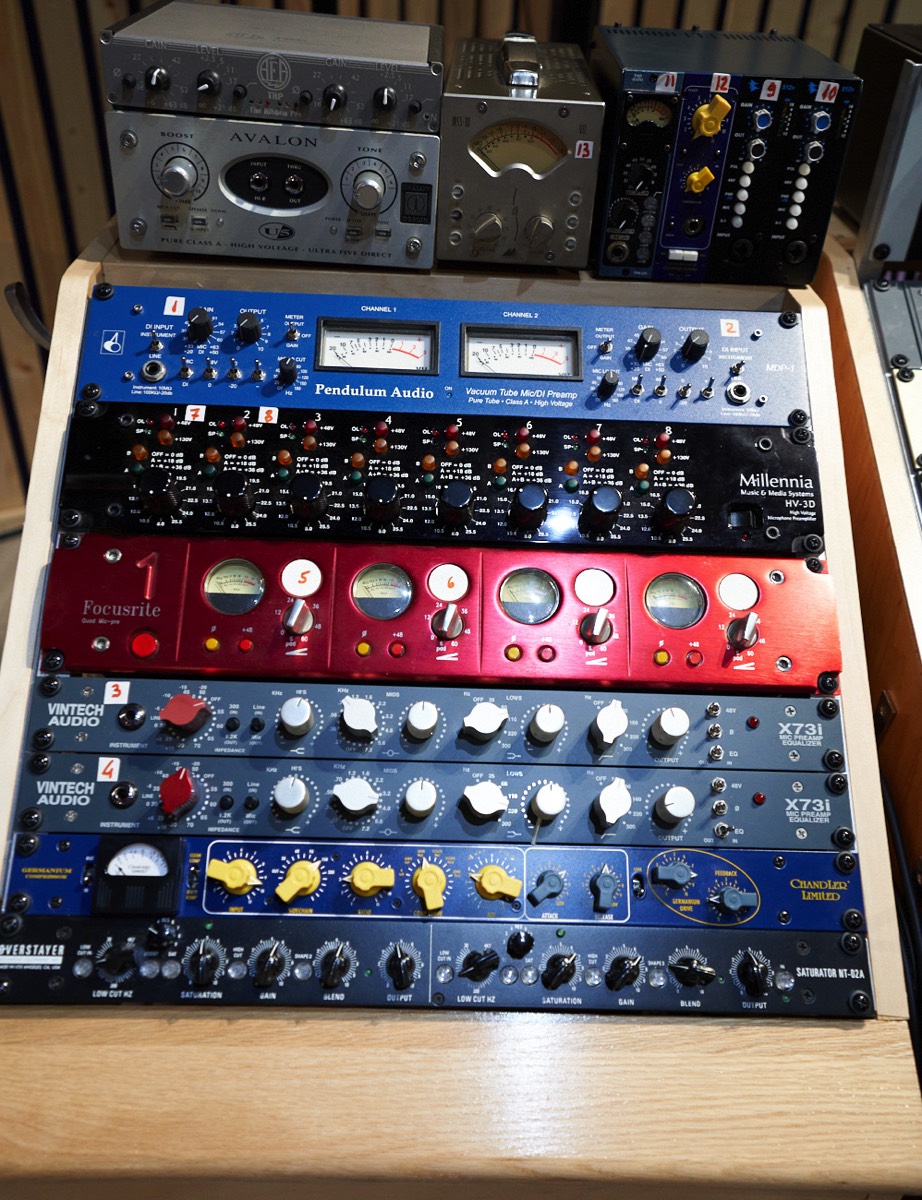
Regarding the preamps: make sure the studio has premium preamps, which are suitable for the style of music you are playing. If you’re a classical musician, or for acoustic instruments, a transparent preamp like Millenia or Earthworks is desirable; for rock, jazz and R&B preamps like Neve, Tree Audio, Chandler, Focusrite Red, Martech, API, Pendulum Audio, Great River, SSL, Fearn, Vintech, Avalon are great options. There’s a reason the Millennia preamp is used almost exclusively all over the world for classical/chamber/choir music, where "clean" and "headroom" are the name of the game.
Of course, great preamps are not cheap. They do cost thousands of dollars! In your studio search you will be told how great Presonus, ART, Mackie and Behringer preamps are. Here is the news: they’re not! They're not bad, they’ll get the job done, but you can’t really compare a 2000 € one channel preamp with an 800 € eight channel preamp or mixer! Look for a studio that has a couple of great different preamps, so you can take advantage and get the best in different recording situations! API, Focusrite Red, Neve or SSL are great for drums; on the other hand, when it comes to record or warm up a synth, a tube preamp like Pendulum, Thermionic or Fearn is a great way to go.
You can skip this paragraph, it’s going to be a little technical, but it gives you a better understanding of why a microphone preamp does a good job. Most everyone knows that we have to avoid clipping during recording; what is not widely known is that, long before clipping, many preamps exhibit an extreme distortion increase, as they change from Class A to Class AB operation. Therefore, it is very important to have at least 6 dB between the peak level of the music and the clipping point to avoid a harsh sound. The difference between the average level of the sound and the clipping point is known as headroom. The bigger the headroom, the better the sound! The high-end preamps have clipping points as high as 37 dBu (+55 Volts), while the semi-pro and consumer equipment have 20 to 24. Simply put, in order to get a good sound, the preamps must have very high output devices and high-voltage power supply, which is very expensive; you won’t get that with 100 dollars per channel preamp. These cheap preamps are good for the hobbyist recording engineer, but they are to be avoided if you are looking for quality! The good preamps or EQ include very high-quality circuits and excellent transformers, and when you have to mic many tracks, you’ll understand it!
As some of the studios ventured in the hybrid analog/digital mixing, check to see what hardware are they using along with their plugins: names like Eventide, Bricasti, Lexicon, TC Electronics for space/reverb/delays; Elysia, Neve 33609, Cranesong, Thermionic, 1176, SSL, API 2500, Retro Instruments, Avalon, Empirical Lab, Pendulum, Manley for compressors; and Neve, Massenburg, Chandler, Millenia, Elysia, Retro Instruments, Avalon, Pendulum, API, Weiss and Manley as EQ’s are quite desirable.
Another thing to look for are the plugins used. It helps if you see the UAD cards with plugins, or native plugins like Sonnox Oxford, Tone Projects, Acustica, DMG, Soundtoys, Fab Filter, Waves, SSL, Lexicon, Altiverb, Eventide, Relab, and so on… After many years of developing better and better algorithms, most of the plugins are excellent. Also, make sure the studio uses good software for voice editing - Melodyne, or Antares. Drums are usually a problem, and a tool for drum replacement like Drumagog, Trigger and even better- the trigger from Superior Drummer 3, can save the day!
Always ask to listen to some music (have some CDs with you) in the same vein with your music through the studio monitors. The monitors are used to judge the tracks, the mix and the mastering. If they're low quality, there will probably be a problem! The studio engineer is used to them and he can do an excellent good job, but there are situations when you will be asked to make some decisions, to accept or redo some tracks, and you may not be able to have an objective opinion! It helps if the studio has 2 or 3 sets of monitors of different makes and sizes, so you can check through all of them! It helps even more if the monitors are made by ATC, Barefoot, Focal, Klein & Hummel, PMC, Adams, KRK, etc - just ask to listen to your CD's and you will notice the difference! They reveal easy any problems and allow an engineer to achieve great balance and imaging.
There are many medium and small studios, and there is nothing wrong with them, especially if they pass the lower overhead costs to you (unlike big studios who can’t afford to do so, as they have a large overhead, due to personnel, rent and expensive maintenance). Just make sure they provide comfort, good acoustics and monitors and good equipment. Beware though: many people are recording with a computer, a cheap console or preamp and cheap microphones. My suggestion is to think twice before you pick the most inexpensive studio as your product will reflect that. A 200 € mic or preamp can’t provide the same quality you get from a 7000 € microphone or preamp (cheap mics made in China working exactly like Neumann is just plain marketing BS, you know they have to make money too! Not that they're terribly bad, they can be useful, but they’re very inconsistent). When you're putting a lot of effort into making a recording, saving one or two hundred dollars at the cost of low quality is a mistake.
In conclusion, always choose the studio that makes you more comfortable and meets your recording needs. What really make the difference are the engineer’s ears and experience, your musicianship, the space you record in and the equipment that captures your performance.